
Foreign exchange reserves as a percentage of India's total external debt were 73 per cent at the end of December 2015.

Israel is determined to take the bilateral engagement to a different level that goes beyond defence hardware and intelligence software. Kanchan Gupta reports exclusively from Tel Aviv for Rediff.com

As India strives to make its Act East Policy a comprehensive politico-diplomatic and economic success, Brunei gains more salience, says Dr Rahul Mishra.

Business reacted with caution to the reforms of 1991, and demanded protection from multinationals and imports. Twenty-five years later, traces of that demand can still be found, reports Bhupesh Bhandari.

The Congress president said that if he was allowed to speak for 15 minutes on a host of issues, including the Nirav Modi scam, PM Modi would "run away".

Prime Minister Narendra Modi has five key aspects to his style of leading -- total command over bureaucracy, direct approval on every decision, flexible approach to issues, importance of communication and adept at repackaging schemes, says A K Bhattacharya.

Prime Minister Malcolm Turnbull's first State visit to India is an indication of the success of India's Act East Policy, says Dr Rahul Mishra.

Taking exception to Health Minister Harsh Vardhan not mentioning the death of healthcare workers due to Covid-19 in his statement in Parliament, the Indian Medical Association has published a list of 382 doctors who died due to the viral disease and demanded that they be treated as "martyrs".

'His essential doctrine was only the local police can fight terror.' '"You can't fire at mobs throwing stones," he said, adding one has to think innovatively, even defensively, sometimes.' Shekhar Gupta remembers the uncoventional SuperCop.

'Modi wants to reverse everything Nehru did, but is shy of touching his daughter's most unwise policies.' 'There is no example of this more stark than bank nationalisation,' says Shekhar Gupta.
'It is imperative that all parties make a commitment that they shall abide by the final decision of the Supreme Court.' 'This will be the best way to bring a closure.' 'It is time India moves on to face several other challenges.'

'Modi, focused on youth and their aspirations, has articulated a truly disruptive change: One of hope, of duties rather than rights, of standing up to the world instead of being bullied by it,' says Rajeev Srinivasan.
Prime Minister Narendra Modi and Home Minister Amit Shah will soon get around to reworking their organisational set-up and administrative priorities to regain lost ground in the wake of the Delhi electoral debacle, but there's third course available to them as well. That is to introduce the presidential form of government, which prime ministers Indira Gandhi and A B Vajpayee flirted with before abandoning it. Will Modi go further than them? N Sathiya Moorthy analyses the scenario.
'The CBI should be bifurcated and the CBI's charter should be restricted to anti-corruption cases.'
'The investigation of major criminal cases having national and international implications, and national crimes spread over more than one state may be entrusted to a new national crime bureau,' recommends Dr Madhav Godbole, the former home secretary.
Siva Sankar looks at S P Balasubrahmanyam's fantastic repertoire.

'This prime minister thinks he knows everything.' 'He has to consult, he has to talk and he has to mobilise the best people, but having seen him function, I have no expectations from him.'

A new West Asia is emerging and India must engage at the highest level and help shape this change, says Saeed Naqvi
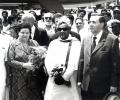
'I was present at a meeting where he decided to permit the IAF to strike at Pakistan positions in Kargil, with the caveat that they should not cross the LoC.' 'Confident that the Indian Army would succeed, Mr Vajpayee was positioning himself to tell the world after the Kargil conflict was won that India did not violate the 'sanctity' of the LoC,' recalls Ambassador G Parthasarathy, who served as India's envoy in Islamabad in that eventful year, 1999.

'We aren't so unreasonable as to demand that he should have fully reversed Indira Gandhi's worst economic legacy, bank nationalisation.' 'But he could have made a beginning by selling off the two most stressed small public sector banks, and then announced that each year for the next 10, one government bank with the most messed-up balance sheet will be sold.' 'It would have electrified the markets, shocked his other banks into better behaviour, and marked his name among the great reformers,' argues Shekhar Gupta.
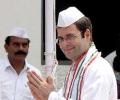
'Sonia Gandhi can't rejuvenate the party, her heir is fodder for stand-up comedians, and nobody in the Congress has the guts to question the Nehru-Gandhis.'
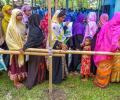
'There is a design of fundamentalists that the north east must become an Islamic country.'

'The timing is a little suspect.' 'Could it be, just be, a convenient tool to wield months ahead of a hyper-crucial state election, judge if its efficacy in sending out its subliminal message is intact, and accordingly decide the future course of action on the long but quick road to 2019?'

The report said Sasikala was allowed to wear her personal clothes and cook. A pressure cooker and spices were found in her prison cell.
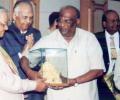
'The D K Adikesavulu clan is so wealthy, owns so many houses, and has so much jewellery,' notes T V R Shenoy, 'that it did not notice a servant stealing at the rate of Rs 66 lakh every year!'

The Indian economy was on an impressive growth path through the first decade of this century till it was brought to an abrupt halt by the policy inertia during UPA2 and the Modi government's inability to restore economic and financial momentum. Fascinating glimpses of what went wrong from Puja Mehra's must-read book The Lost Decade: How India's Growth Story Devolved Into Growth Without A Story.

'This coming general election is not going to be about manifestoes.'

'There is no danger of the suggestion being accepted in a hurry, as we are still discussing the design of an IFS tie and trainee officers are still taught how to handle forks and knives.'

'Voters did not turn up in large numbers in Bangalore.' 'If more voters of Bangalore had come to vote, we would definitely have reached the magic figure.'

A look at few gurus who have attracted controversy in recent times.
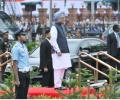
Amberish Kathewad Diwanji tweaks the prime minister's Red Fort speech.

'The country has moved beyond the likes of Yogi Adityanath and his medieval thinking. The results of the by-elections are early warning signals by impatient Indians. It's up to the BJP to learn its lesson or face the consequences,' says Ashutosh.
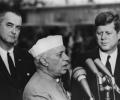
As Prime Minister Narendra Modi begins his historic visit of the United States of America, here's a look at some landmark visits by Indian prime ministers to the United States of America.

He challenged the Congress to select someone 'capable' as its president, who did not belong to 'that one family'.
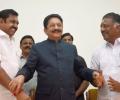
The BJP's national leadership seems to have convinced itself that with a weakened, post-Jaya AIADMK for company, they should be able to strike roots before long, and start by winning about 10-15 Lok Sabha seats in 2019, says N Sathiya Moorthy.

'Modi's idea of India is to make it less liberal, less tolerant and a less accommodative of diversity.' 'We are headed, if Modi continues, to become an ill liberal democracy.' 'Modi is not Vajpayee. Vajpayee was fundamentally decent, tolerant and fair. He played by the rules of the game. Modi is a different story.'
